WRITING, books, essays, quotations, IDEAS, sentences, phrases, apostrophes, WORDS
Ian F Freer, MA(Cantab)
Wordworks:
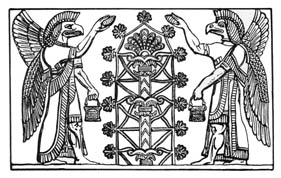
"Some of the abstract trees shown in Assyrian art are clearly pomegranates, as the fruit is distinctive, but many others are much more like date palms. Parpola notes that this artistic form of the Tree is principally
characterized by the “garland” of cones, pomegranates, or palmettes surrounding its crown and/or trunk. I suggest that the pomegranates designate that species and the palmettes designate a palm tree."
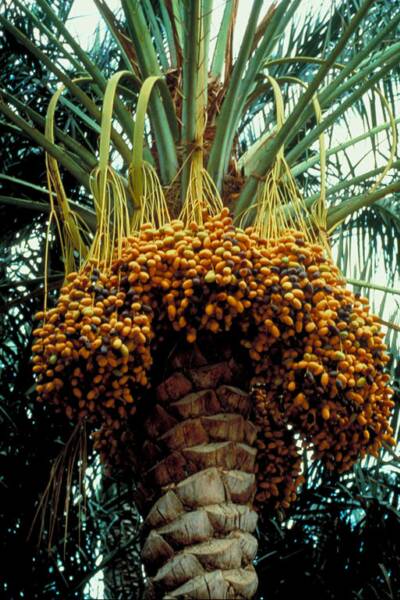
"If the date palm is the main Tree of Life commonly shown on the Assyrian palace reliefs, this could neatly explain the lattice work pattern that is so evident. The trunk of the commonly seen variety of palm tree is patterned in that way because it grows upwards with new leaves, which leave the lattice pattern when they fall off. Another possibility is that branches of trees were deliberately tied together at the nodes and
fashioned into a lattice; or living branches were trained in those directions
as an espalier."
Excerpts:
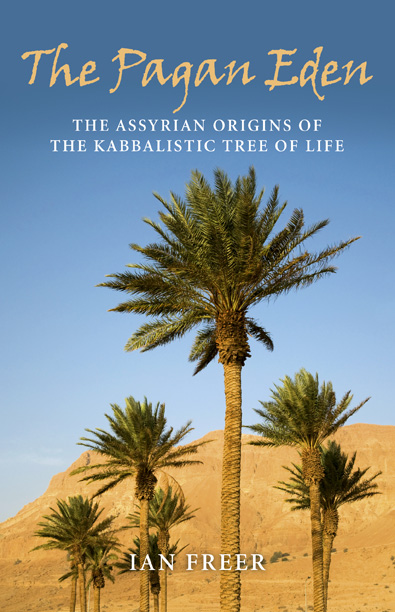
The master key to ancient original Kabbalah revealed at last: The Tree of Life is a family tree from ancient Iraq.
From the Publisher, John Hunt Books:
This is the first complete book about the Babylonian Kabbalah, which many people are talking about on the Internet. Assyria in Northern Iraq is the home of Palace Art from the Courts of the Assyrian Empire, where the Tree of Life was routinely shown on walls, tended by winged genies. It represented the King and the Land. It is also arguably a spiritual map and the basis of the Jewish Kabbalah, which was developed later. Many authors have asserted that the Kabbalah came from Egypt but this book shows that its early roots lie in Assyrian Court Art. There are also fascinating parallels to Asiatic Shamanism. All points to Asia, not Africa, as the home of the archetypal Sacred Tree image.
.gif)